
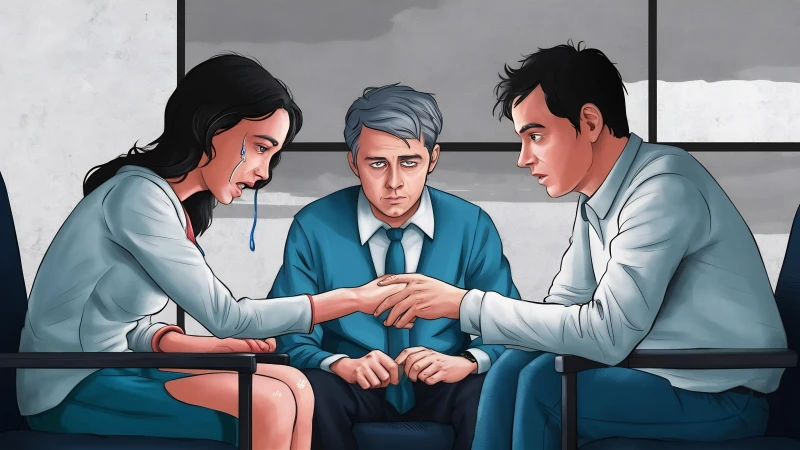
Prolonged grief disorder — also referred to as complicated grief — is a clinical condition in which grief following the loss of a loved one does not follow the expected course of natural mourning, but instead becomes fixed, prolonged, and significantly impairing. It is recognised as a formal psychiatric diagnosis in both DSM-5-TR and ICD-11, reflecting growing clinical consensus that there is a qualitative difference between normal grief — however painful — and grief that has become a disorder requiring clinical attention.
Grief is a universal and necessary human experience. The pain of losing someone important is not pathological. What distinguishes prolonged grief disorder is not the intensity of the pain but its trajectory: the inability to adapt to the loss, the persistence of acute grief beyond an expected timeframe, and the significant impairment in functioning that results.
Prolonged grief disorder is characterised by intense, persistent longing for the deceased; difficulty accepting the reality of the loss; emotional pain — bitterness, anger, guilt, or numbness — that does not diminish over time; difficulty engaging in daily activities, relationships, or planning for the future; a sense that life is meaningless without the person who has died; and an inability to experience positive emotions or imagine a future.
These features persist beyond the acute mourning phase — typically beyond twelve months in adults, or six months in children and adolescents — and cause significant impairment in functioning.
Prolonged grief disorder must be distinguished from major depressive disorder and PTSD, both of which can co-occur with grief and share some clinical features. Assessment must be culturally informed and sensitive to the specific circumstances of the loss.
Not all losses are equal in their clinical complexity. Traumatic or sudden losses — the unexpected death of a child, suicide bereavement, violent death, mass casualty events — carry a significantly elevated risk of prolonged grief disorder. These losses involve not only the loss itself but the traumatic circumstances in which it occurred, producing a clinical picture that combines grief with significant trauma symptoms.
In Israel, the clinical context of grief is shaped by the reality of military loss, terrorism, and mass casualty events. The losses of October 7, 2023 — sudden, violent, and on a scale that affected the entire society — have produced grief presentations of extraordinary complexity. IsraClinic has clinical experience with grief in this specific Israeli context, including bereavement following military loss, traumatic death, and the grief of families of hostages and missing persons.
Prolonged grief disorder is not only a disorder of emotional pain. It is often, at its core, a crisis of meaning — the loss has disrupted not only the survivor's attachment to a person, but their relationship to life itself, to purpose, and to the future.
Valery Kravitz, director of IsraClinic and author of the psychological support practice Facing Death Honestly («Со смертью на «ты»»), has worked extensively with the existential dimensions of grief — the confrontation with mortality, the difficulty of continuing to live after catastrophic loss, and the process of finding a meaningful path forward. This existential dimension is integrated into IsraClinic's clinical approach to grief.
Assessment includes a comprehensive clinical interview examining the nature of the loss, the relationship to the deceased, the trajectory of grief since the loss, current symptom profile, functional impairment, and co-occurring conditions — particularly depression, PTSD, and anxiety. Cultural and religious context is a central component of assessment.
Where the loss was traumatic, assessment includes evaluation of trauma symptoms alongside grief features — as these require different but complementary treatment approaches.
Prolonged Grief Therapy (PGT) — developed by Dr. M. Katherine Shear — is the most evidence-based psychotherapeutic approach for prolonged grief disorder. It combines cognitive-behavioral and exposure-based approaches with grief-specific work, including revisiting the story of the loss and working toward acceptance and adaptation.
EMDR is particularly indicated where traumatic bereavement involves significant trauma symptoms alongside grief — providing a pathway to processing the traumatic dimensions of the loss.
Supportive psychotherapy and existential approaches address the meaning-related dimensions of grief — the reconstruction of a life narrative that can accommodate loss and find purpose and engagement with the future.
For individuals whose grief includes terror about their own mortality or the mortality of those around them — IsraClinic's integrative approach, including Valery Kravitz's Facing Death Honestly practice, addresses these dimensions directly.
Where co-occurring depression, PTSD, or anxiety are clinically significant, pharmacotherapy may be indicated alongside psychotherapy. Digital prescriptions are issued through the Yarpa system.
If grief following the loss of a loved one has not diminished over time, is significantly affecting your ability to function, or has left you unable to imagine or engage with the future — professional assessment is appropriate. There is no obligation to manage this alone, and effective help is available.
IsraClinic accepts patients for in-person consultation in Tel Aviv and online, in English, Russian and Hebrew. No referral is required.
Clinical Reviewer: Dr. Mark Zevin, MD — Senior Psychiatrist | Valery Kravitz — Clinical Programme Curator | IsraClinic | Last reviewed: 2026
Grief that does not ease over time deserves clinical attention — not because something is wrong with you, but because the right support makes a real difference. Our team is available in English, Russian and Hebrew.
Transparent rules: how the clinic is licensed, which rights every patient has and what to expect from treatment.