
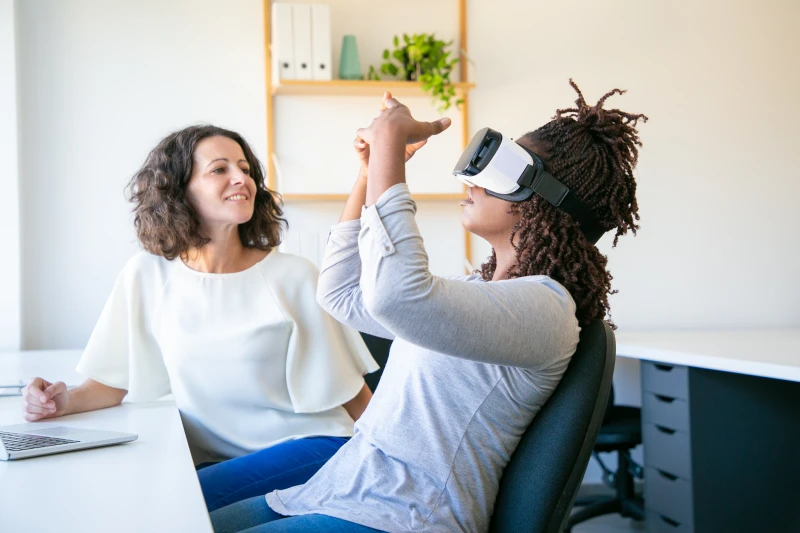
Virtual Reality Therapy (VR Therapy) is a clinical approach that uses immersive virtual reality technology as a therapeutic tool — creating controlled, three-dimensional environments in which patients can engage with therapeutic scenarios in a way that is not possible in a standard clinical setting.
VR therapy is not a replacement for traditional psychotherapy. It is a precision clinical tool that, when integrated into a broader therapeutic plan, enhances the effectiveness of evidence-based approaches — particularly for anxiety disorders, phobias, PTSD, and social anxiety — by providing a level of environmental control, immediacy, and realism that standard exposure-based therapy cannot replicate.
At IsraClinic, VR therapy is delivered using the Amelia platform by XRHealth — a certified clinical VR system. IsraClinic holds a Certificate of Introduction to Virtual Reality Techniques Applied to Clinical Psychology, issued by Amelia by XRHealth.
VR therapy works primarily through exposure — the evidence-based principle that controlled, graduated confrontation with feared stimuli reduces anxiety and avoidance responses over time. In traditional exposure therapy, this confrontation is imagined or arranged in real-world settings. VR provides a third option: immersive, controllable, and repeatable virtual environments.
The patient wears a headset that places them in a virtual environment selected to address the specific clinical target — a feared situation, a social context, a challenging scenario. The therapist controls the parameters of the environment in real time, adjusting intensity and complexity as the patient's clinical response dictates.
Because the virtual environment can be precisely calibrated and immediately modified, VR exposure is more graduated, more consistent, and more reproducible than real-world exposure. The patient can practise repeatedly until the anxiety response diminishes — without the logistical constraints and unpredictability of real-world settings.
Anxiety disorders and specific phobias — fear of heights, fear of flying, claustrophobia, social phobia, and other specific fears — respond particularly well to VR-based exposure. Precise environmental control and unlimited repetition make VR an ideal platform for phobia treatment.
Social anxiety disorder — VR social situations including job interviews, presentations, and social gatherings allow the patient to practise and habituate in realistic but controllable conditions, without the full consequences and unpredictability of real social settings.
PTSD and trauma — VR creates safe approximations of trauma-related environments, supporting graduated exposure under careful clinical supervision — particularly useful where real-world exposure is logistically difficult or clinically premature.
Panic disorder and agoraphobia — VR environments simulating crowded places, public transport, or open spaces support graded exposure and reduce avoidance.
Chronic pain and rehabilitation — VR has applications in pain management supported by a growing body of clinical research.
VR therapy at IsraClinic is conducted in person at the Tel Aviv clinic using the Amelia clinical VR platform. Sessions are conducted by trained clinical staff under the supervision of the clinical team.
VR therapy is not offered as a standalone intervention. It is integrated into a broader therapeutic plan — typically alongside CBT, EMDR, or other evidence-based approaches — and its use is clinically indicated, planned, and reviewed as part of the overall treatment.
The therapist remains actively present throughout each VR session — monitoring the patient's response, adjusting the environment in real time, and conducting the cognitive and processing work that makes exposure clinically productive rather than simply confrontational.
All VR therapy at IsraClinic is delivered within the framework of the Psychoergonomic Method — ensuring its use is embedded in a comprehensive clinical understanding of this specific patient's presentation, history, and therapeutic goals.
VR therapy is indicated when exposure-based treatment is clinically appropriate and the patient would benefit from a controlled, graduated, and repeatable virtual environment — particularly for phobias, social anxiety, panic disorder, and PTSD where real-world exposure is logistically challenging or premature.
It is not appropriate for patients with severe dissociative symptoms, active psychosis, or certain neurological conditions. The treating team will assess suitability before VR therapy is recommended.
IsraClinic accepts patients for in-person consultation and VR therapy sessions in Tel Aviv, in English, Russian and Hebrew. No referral is required.
Clinical Programme Curator: Valery Kravitz | IsraClinic | Last reviewed: 2026
VR therapy makes it possible to face difficult situations in a safe and controlled environment — one step at a time. Our team is available in English, Russian and Hebrew.
Transparent rules: how the clinic is licensed, which rights every patient has and what to expect from treatment.