
Reaching out to a psychiatric clinic for the first time takes courage. Many people spend months — sometimes years — considering it before making contact. If you are reading this page, you have already taken a significant step.
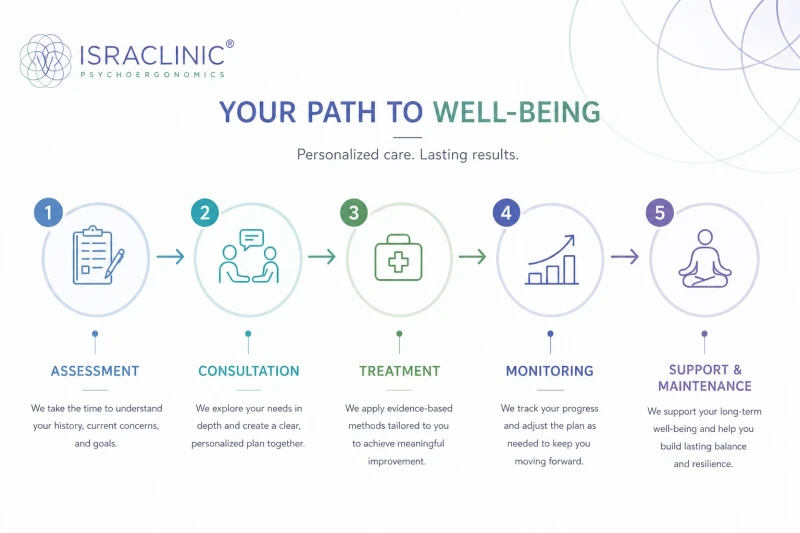
This page describes what you can expect from the moment you first contact IsraClinic to the end of your treatment. We want the process to feel predictable, transparent, and as comfortable as possible.
You do not need to have a clear diagnosis, a referral, or a complete understanding of what is happening to you in order to reach out. A brief description of what you or your family member is experiencing is enough to begin.
Your initial message — whether by email, contact form, or WhatsApp — is received by a member of the IsraClinic team, not an automated system. It is treated as confidential from the moment it arrives. You will receive a direct, personal response.
If the situation is complex or urgent, we may ask to speak with you briefly by phone before the first consultation — to understand the context and make sure we can offer the right kind of help.
Once we have confirmed that IsraClinic can assist, you will be asked to sign a treatment agreement and a personal data consent form. This exists to protect your rights — not to create obstacles.
You will then be asked to share any relevant medical documentation: previous diagnoses, treatment records, test results, or discharge summaries. If you have nothing, that is also fine — we will build the clinical picture from the consultation itself.
Everything you share is handled in strict confidence and seen only by the clinical team members working with you.
The first consultation with an IsraClinic psychiatrist takes place online — regardless of whether you plan to continue treatment in person or remotely. This is a full clinical appointment, not a screening call.
The doctor will listen carefully. You will be asked about your current difficulties, your history, your daily life, and what has or has not helped in the past. There are no wrong answers and no expectations about how you should present yourself. The purpose is to understand your situation — not to fit you into a category.
At the end of the consultation, the doctor will share their initial clinical impressions and outline what the next steps might look like.
Based on the consultation and your documentation, the IsraClinic team prepares an individual diagnostic or treatment programme — built specifically for your case, not drawn from a standard template.
You will receive a written outline of the proposed programme, including what it involves, how long it is expected to take, and the full cost. You have the opportunity to ask questions, request changes, or seek a second opinion before agreeing to anything. Nothing proceeds without your confirmed consent.
For patients travelling to Israel for in-person treatment, the clinic team coordinates arrival dates, scheduling, and logistics if needed. When you arrive at the clinic at 43 Brodetsky Street in Tel Aviv, you will find a calm, quiet environment. There are no hospital wards, no white coats, and no institutional atmosphere. The space is designed to feel private and unhurried.
Your first in-person appointment begins with a meeting with your treating psychiatrist. The programme is reviewed together, adjustments are made if needed, and the full process is explained again in person.
Diagnostics at IsraClinic are conducted over multiple stages. Depending on your case, this may include neurological examination, laboratory tests, neuroimaging, and structured psychological assessment using clinical interviews and projective tests.
Each stage has a purpose, and that purpose will be explained to you before it begins. You will not be asked to undergo any procedure that has not been discussed and agreed in advance.
Treatment at IsraClinic is outpatient. You will not be admitted to a ward. Your programme will specify which appointments take place on which days, and the schedule is designed to be manageable — not exhausting.
All specialists involved in your care work in coordination with each other. They share clinical observations, review your progress collectively, and adjust the programme if something is not working as expected. You are informed of any significant changes.
If you have questions between appointments, you can contact the clinic. You will not be left without a point of contact.
If you are receiving treatment remotely, the process follows the same clinical logic. Consultations take place via secure video connection. The scheduling, monitoring, and coordination between specialists are the same. Clinical standards do not change based on the format.
When your treatment programme is complete, you receive a full clinical summary — the epicrisis — and all relevant documentation. This includes diagnostic conclusions, treatment provided, medications prescribed, and recommendations for ongoing care if needed. If you are returning to another country, documentation is prepared in a format suitable for continuity of care with a local physician.
You will not be rushed. You will not be given a diagnosis in the first five minutes. You will not receive a generic treatment plan. You will not be asked to fit a protocol that does not fit your situation. And you will not be treated as a case — you will be treated as a person.